The Price of Freedom Is Visible Here
The Price of Freedom Is Visible Here I read those words today on the front of a building. The Price of Freedom Is Visible Here. I was there with my husband, a Vietnam veteran, waiting while they dilated his eyes. And I stood in that parking lot looking at the armed forces emblem and those words and I felt something land in my chest like a stone. Because I know the price of freedom. I just never got a plaque for it.
Sharri Burggraaf
4/17/20266 min read
The Price of Freedom Is Visible Here
I read those words today on the front of a building.
The Price of Freedom Is Visible Here.
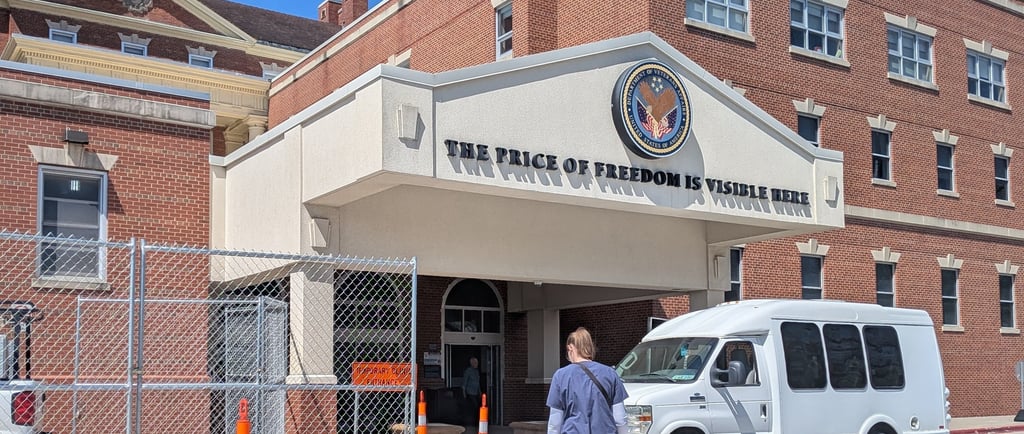
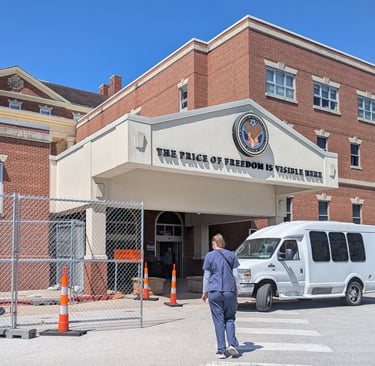
I was there with my husband, a Vietnam veteran, for his eye appointment. As we were walking into the VA hospital, I looked above the doorway where the words were right below the armed forces emblem, and as I saw the words, I felt something land in my chest like a stone.
Because I know the price of freedom.
I just never got a plaque for it.
We drove a highway home today that I have driven more times than I can count. I drove since he had gotten his eyes dilated. For years we drove it together to therapy sessions that gave me words but not always healing, where I could talk but the real turning point — the place where my nervous system finally began to believe it might be safe — came not from a clinical hour with a counselor but from the moments my husband simply held me and let me cry.
Thirty-six years he has been beside me in this war. He didn't know what we were fighting when we started. Neither did I. We discovered it together, the way you discover a minefield — one painful step at a time, then research, then the slow, terrible clarity of understanding what had actually been done and by whom and why.
He is a Vietnam veteran who came home to a country that pretended his war didn't happen. He married a woman whose war the country still pretends didn't happen. And today, after they dilated his eyes and we drove home in the afternoon light, I realized something.
His eyes are wide open. Not from having dilated pupils, but just like mine opened in 1984 after my dad died, so were mine.
I have been thinking as of recent about what the war actually was. Not a foreign country. Not a distant battlefield. The enemy came here. It was allowed here. Our own government allowed 1600 German Nazi scientists to come into the United States. It embedded itself in institutions, in programs with government names like Operation Paperclip, Project Monarch, MKUltra with government funding, in the machinery of power that is supposed to protect its own people. It targeted children. It targeted military personnel. It found its way into schools and universities, churches and homes.
It was a stealth operation that occupied far too many lives. A silent takeover. A war waged in the dark against people who had no idea they were soldiers, let alone prisoners of war. They called themselves government. They acted like God.
And I — one person, one child, one woman — had to claw my way out of rubble they left inside me. Had to conduct a rescue mission and an archaeological dig simultaneously, going back into the wreckage to find the parts of myself that had shell shock, that had gone underground, that had stopped speaking because speech was dangerous and stopped feeling because feeling was unbearable and repressed and disconnected.
I didn't know the war was over. That is the cruelest part of what they did. Your nervous system doesn't get a telegram. It just keeps firing.
When the dam broke internally from all I had been holding back, nightmares and terror came first. Then panic attacks. Then anxiety. Then — eventually, slowly, with Frank's arms around me and God's grace underneath everything — occasional moments of peace. And then more peace. And then something that began to feel like ground.
I have taken my territory back.
But today I have to ask the question I have been carrying for a long time and cannot carry quietly anymore.
Does the war ever end?
I am one of ten children. My father tried to get help. He went to a psychiatrist and they finally found a medication for his relentless depression and anxiety. He went to a support group an hour away. He didn't get very far, but he tried, and I saw him try, and something in me learned from that trying. And I became the only one of the ten who went all the way — who did the hardest work, who clawed through every layer, who refused to stop until I had found myself on the other side.
I thought if I could do that, maybe I could stop it, this cycle of multigenerational abuse. Maybe I could be the wall the damage broke against so it didn't reach the next generation. But damage doesn't always stop at walls.
It had already reached my children because I married an abusive man who was my handler. I never loved him. He never loved me. I was his next victim and I didn't think I was worth anything so I didn't think I deserved any better. He held power and control over me and I thought that my love could make up for what the children didn't get from their father. And while I tried to shield them, my children were harmed by the damage that was done. Between my falling apart and the effects of my trauma doing its own damage to my children and the angry father they had they were getting it from both sides. I think that you can't even see your own pain until you heal, much less what is happening to your own children. All you and they are doing is surviving a war that none of us asked for and none of us even knew what hit us.
My oldest daughter — the one her father didn't even want, the one he leaned on like a spouse when she was still a child when I got a divorce, making her carry what no child was ever meant to carry — has been married and divorced twice and is raising seven children alone. My son has struggled with alcohol since he was sixteen. There has been much healing with my oldest daughter and my son. They both have done lots of healing. My youngest is the steadiest, and I am grateful for every mercy in that.
And now the next generation. My grandson, has been alcoholic, and suicidal. Another grandson who spent years in a basement playing video games and now as a father of 2 still is missing in action as he plays the video games on a YouTube channel and he doesn't even realize that he is a boy who never got to learn how to be a man and have the tools to live his life without the battle scars. My granddaughter, running away, harming herself, wanting to die most days, trying to find her way through questioning her identity and gender who went to therapy for five years and is still searching for the same answers. Her sister is now doubting God, which we all do at times, but she is the quiet one who may be holding an entire war within her that has no way to come out.
And I want to know — God, I want to know — when does it stop?
Can one person actually break a cycle that runs this deep? Or do we simply do the work, plant what seeds we can in damaged soil, and trust that somewhere three generations out something will bloom that we may never live to see?
I think about what was on that VA wall today.
Honoring our commitment. To care for him who shall have borne the battle.
The veterans deserve those words. Every one of them. The acknowledgment came late and incomplete and my husband still doesn't qualify for the compensation he should have, because the damage wasn't quite severe enough by their measure, as if suffering has to reach a minimum threshold before it counts.
But at least someone put words on a wall.
At least someone said: you were in a war. We see you. The price you paid was real.
I am still waiting for those words. My friend who tried to take her life this month is still waiting. The thousands of survivors coming forward are still waiting. And while we wait, our children and grandchildren are fighting wars they didn't start, with wounds they didn't choose, in bodies that learned alarm before they learned safety.
I don't have a clean answer to the question of whether one person can stop it. I do know that I have a thirty-six year relationship with a man who held me while I shook, who believed me when the world didn't, whose eyes and mine are both open and have been for many years. I have three children who show scars but are doing the healing that they need. I have a granddaughter who spent five years in a therapy room.
I have a God who says He will restore what the locusts have eaten — not maybe, not if you qualify, not pending evidence review. He said it and He is doing it.
And I have the stubborn, unreasonable, relentless belief that the work we do matters even when we cannot see how. That the cycle bends, slowly, painfully, imperfectly, toward something other than what it was. That the children of survivors who finally got free carry something different in their bodies than the children of survivors who never did.
Even if it takes generations to fully show.
Even if I never see the full harvest of what I planted.
Even if the war isn't over yet.
I drove home today on a highway I have driven a hundred times.
And for the first time, I noticed how much of it I am no longer afraid of.